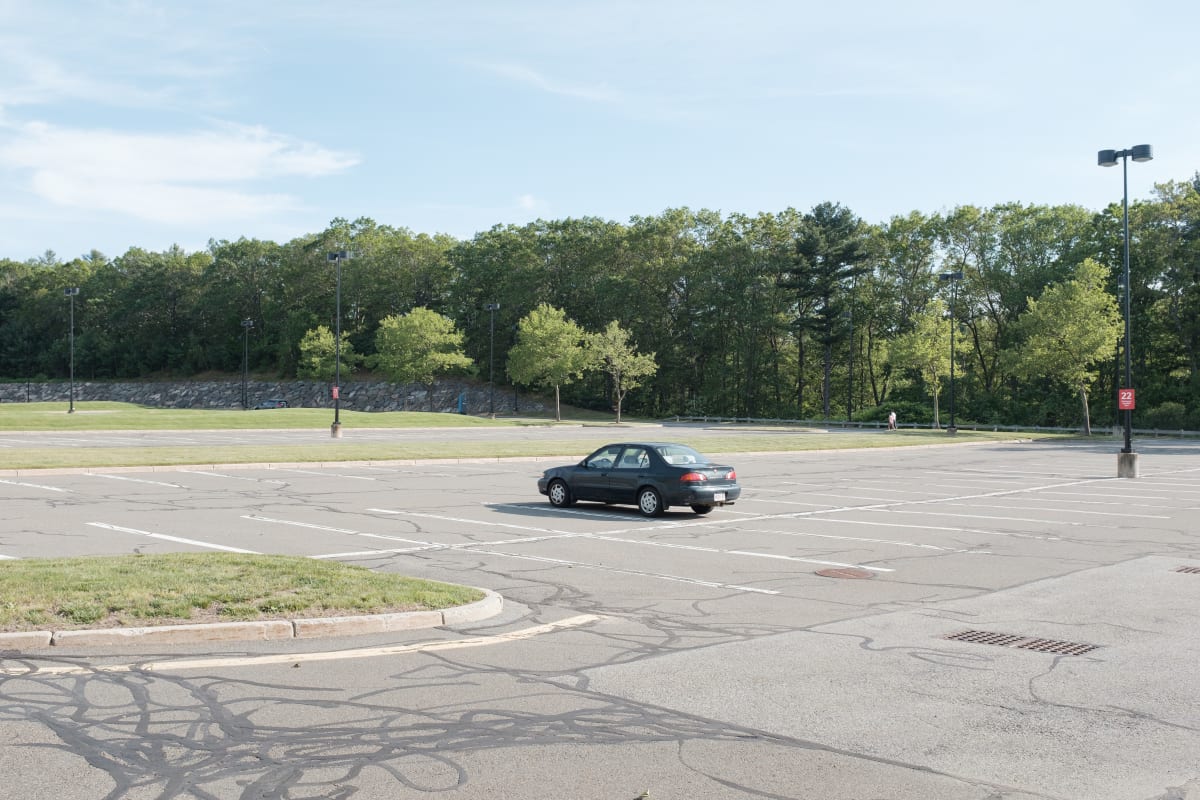
Barthes set to discover the fundamental features of Photography (with a capital P), “the universal without which there would be no Photography,” its noeme. Camera Lucida consists entirely of aphorisms, fragmented investigations which, after a few paragraphs, are abandoned for the next.
It was a delight to find Barthes working with the same threads — few but certain — that I too tug at: the same examples, metaphors, stubbornness, the same interest in a vague phenomenology (“so readily did it agree to distort or to evade its principles according to the whims of my analysis”). I felt at home at last.
The noeme of Photography, or the “that-has-been,” Barthes argued, is an irrefutable fact of Photography, a scientific (and perhaps the only) certainty of physical causes and chemical effects. On this I agree with the same stubbornness, even when digital manipulations and fabricated origins are now as common as deceptions have always been in our words. Such images can be anyone’s concern but mine; they are anything but Photographs with a capital P.
Imagine my contrariness, then, when I realized how the slightest permutations of words and emotions could lead to diametrically opposed conclusions (e.g., our reading of Blow-Up). Here is a Spectator (in his triad of Operator/Spectator/Spectrum) engulfed in grief, speaking “flatly of Death” and painstakingly of wounds (just as he promised). Camera Lucida is a work of mourning, an elegy secretly coveting a hermeneutic necromancy chanting “that-has-been.” The photographed, so he claimed (and prayed), “protest their former existence,” which, by a matter of luck, may retain their former individual essences. Alas, just like Barthes, I found myself “‘scientifically’ alone and disarmed.”
To Barthes, the punctum cannot be named and thus a cast of the dice: Mapplethorpe’s “hand at the right degree of openness, the right density of abandonment.” Whereas any intention the Operator has in photographing necessarily results in studium; she speaks only in studium; she cannot speak except in words. I disagree with the same stubbornness.
(But if my words have so far failed, mutilating what I truly feel, and every time I speak, language evades me yet invades her — still I refuse silence — can I not speak in Vonlenska?)
I choose henceforth to write as the Operator — for the photographs that could have existed, images of the anonymous and the asleep (for it is in the unposed posture that I find comfort). I write — and speak — the punctum of reality. I shall take an elaborate detour and work backwards through the second-order integral, from scarecrows to unicorns.